When it runs, and what a day is like
Sumo tournament schedule and the day itself
The six-tournament calendar, how to read the Association's schedule, and what a tournament day looks like, from getting to Ryogoku to the last bout.
Browse all sumo experiences ↗Quick answer
Grand Sumo has six 15-day tournaments a year, in January, March, May, July, September and November. Tokyo hosts three, and Osaka, Nagoya and Fukuoka host one each. Each runs from a Sunday to a Sunday. The Japan Sumo Association publishes the exact dates, sale dates and venues on its schedule page, so read them there. On the day, bouts run from the morning with the lowest ranks and build to the top division in the afternoon.
The six tournaments: city and venue
| Month | City | Venue |
|---|---|---|
| January | Tokyo | Ryogoku Kokugikan |
| March | Osaka | EDION Arena Osaka |
| May | Tokyo | Ryogoku Kokugikan |
| July | Nagoya | IG Arena |
| September | Tokyo | Ryogoku Kokugikan |
| November | Fukuoka | Fukuoka Kokusai Center |
The calendar: months and cities
Professional sumo follows a fixed pattern: a tournament every second month, starting in January. Each runs for 15 days, from a Sunday to a Sunday, and the exact dates shift a little from year to year, so this guide gives none. Tokyo hosts the January, May and September tournaments at the Ryogoku Kokugikan. Osaka hosts March, Nagoya July and Fukuoka November. The Association publishes the dates several years ahead, so you can plan a trip well before tickets go on sale. Between tournaments the Association also runs provincial tours around the country; they have their own schedule page and are separate from the tournaments.
How to read the Association's schedule page
The Association's English schedule page lists, for each tournament, the venue, the date advance tickets go on sale, the date the new ranking sheet is announced, and the first and last day. It covers several years at once. The ranking sheet, called the banzuke, matters if you want to know who will fight: wrestlers are promoted or demoted after each tournament according to their 15-day record. Use the schedule page to fix your dates, then use the ticket page for the sale date. The same site carries each day's bouts, results and past champions once a tournament is under way.
Which city to pick
Tokyo gives you three chances a year and the simplest visit: the Kokugikan stands by Ryogoku Station, and the area has the Sumo Museum and many training stables. Osaka's tournament is held at EDION Arena Osaka, in the Namba district. Nagoya's is held at IG Arena, so older sources may name a different venue. Fukuoka's is at the Fukuoka Kokusai Center. The format and ceremonies are the same in every city, so choose the city your trip already includes.
How the 15 days build
Each wrestler in the two top divisions fights once a day against a different opponent. Wrestlers in the lower divisions fight on only seven of the 15 days. The wrestler with the best record in a division wins its title, and the top division's champion receives the Emperor's Cup on the final day, after the last match. A wrestler who finishes with eight or more wins usually moves up the rankings, and one with a losing record usually moves down. Every top-division wrestler fights on every day, so any day shows the top division.
What a tournament day looks like
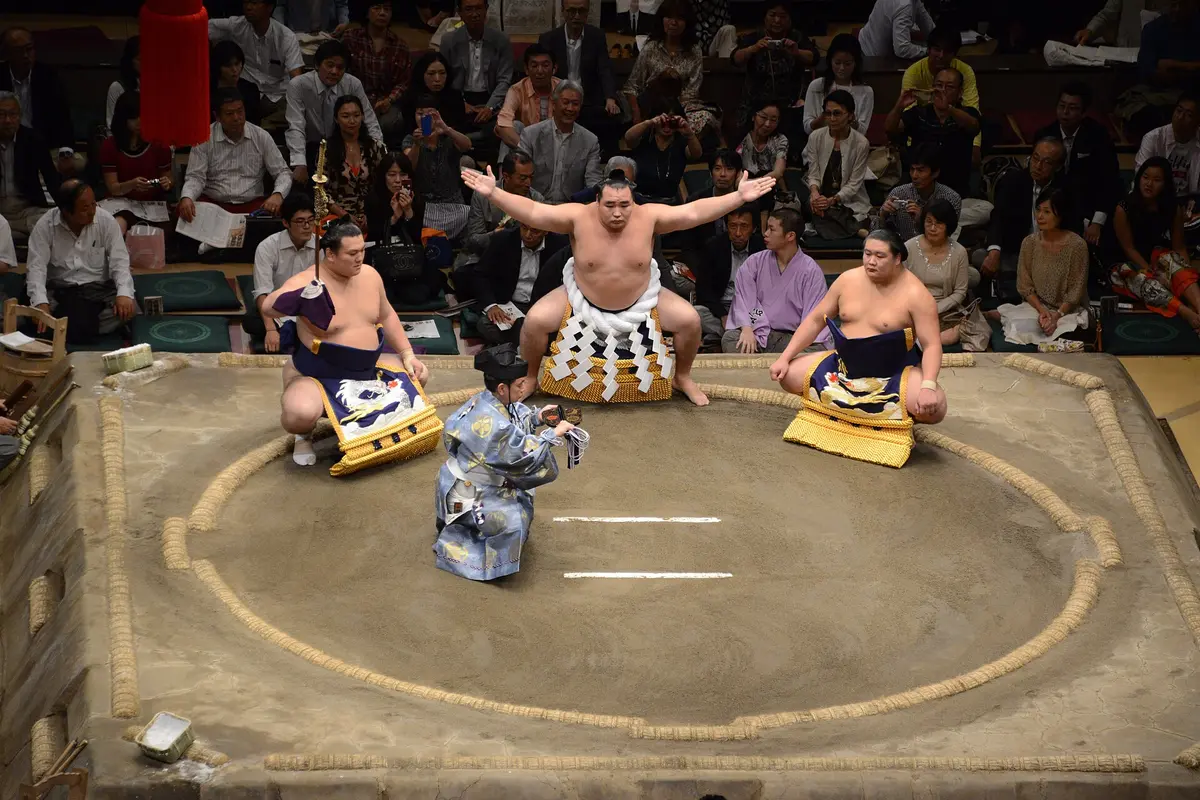
Bouts start in the morning with the lowest-ranked wrestlers, and the ranks rise through the day. Just before the top-division bouts the wrestlers enter the ring in turn wearing embroidered silk aprons, and each yokozuna then performs a ring-entering ceremony of his own. The official ticket pages say the top-division bouts begin in the afternoon and the programme ends in the early evening. After the last bout, a wrestler performs a bow-twirling ritual to close the day.
Seeing and hearing a bout
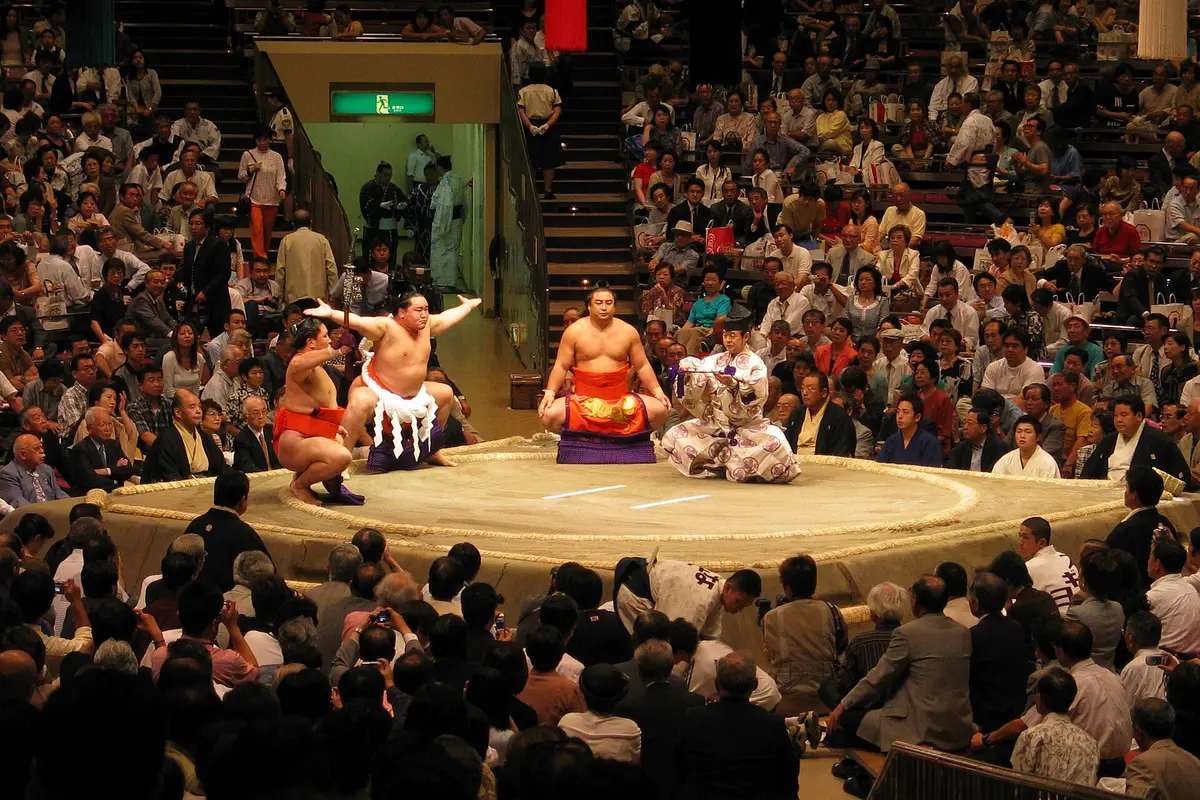
Most of a bout is preparation. Each wrestler rinses his mouth with water, wipes his body and throws a handful of salt into the ring to purify it. They crouch facing each other and return to their corners for more salt, again and again, usually using the full four minutes allowed in the top division. The referee calls their names in a trained voice and signals the start with his fan, and five judges sit around the ring. Once it starts, a bout is usually over in less time than the build-up took. There are no weight classes, so a wrestler can face an opponent twice his weight. Punching, hair pulling, choking and kicking are prohibited.
Read next: Sumo rules explained: how a bout is won
Coming and going, and the rules of the room
A ticket covers the whole day and you can leave and come back, but re-entry rules differ by venue and tournament, from none to unlimited, so read the page for yours. Doors open at a set time each day, later on the last days of several tournaments, and the official page gives the time. The Association's spectator rules for the arena say:
- No bottles, cans or ice boxes
- No bags too big for your seat space
- No strollers in the seating area; the information desk keeps them
- No trumpets, drums or whistles, no paper streamers or confetti, and no flash
- No smoking inside the arena; use the marked smoking areas
Food, drink and the arena itself
Food and drink are sold inside: GO TOKYO lists alcoholic drinks, traditional food and merchandise for individual wrestlers. The Kokugikan makes its own yakitori skewers in its basement. There are no televisions in the arena; the referee and five judges decide each bout. Chanko-nabe, the wrestlers' stew, is served at many restaurants around the arena. Outside food is limited by the rules above: bottles, cans and ice boxes stay outside.
Getting to Ryogoku
The Association says the Kokugikan is a one-minute walk from JR Ryogoku Station on the JR Sobu Line, and a five-minute walk from Exit A4 at Ryogoku Station on the Toei Oedo Line. GO TOKYO gives about 22 minutes from Shinjuku on the JR Sobu Line, and about 55 minutes from Haneda Airport and 90 from Narita Airport by train. The Sumo Museum is on the arena's first floor and is free to enter outside tournament days, though it keeps its own calendar. On tournament days its doors open only to ticket holders.
Children, access and language
Children aged 4 and over need their own ticket, and several official pages say there is no child discount. Wheelchair users need a dedicated wheelchair seat, which covers the user and one companion, and the way to reserve it differs by tournament and can be by phone in Japanese only. The Association's English site lists each day's bouts and results, which helps you follow who is on. Box seats are on the floor, so chair seats are the easier choice for anyone who finds sitting on cushions hard.
Who this isn't for
If your trip overlaps none of the six tournaments, a calendar can't help you, and a practice visit or a show fits better. If you want only a short look at sumo, a tournament day is long: bouts run from the morning to the early evening. If you can't commit to a date before the sale opens, remember that official tickets can't be changed or cancelled. And if you can't sit for hours, plan on chair seats rather than box cushions.
Frequently asked questions
When are the Grand Sumo tournaments?
Six times a year: January, March, May, July, September and November, each for 15 days from a Sunday to a Sunday. The Japan Sumo Association's schedule page lists the exact dates, venues and ticket sale dates, several years ahead.
How long is a sumo tournament day?
Long: bouts run from the morning to the early evening, and a ticket covers the whole day. The top-division bouts begin in the afternoon, so you can choose how much of the lower divisions to watch. Re-entry rules differ by tournament.
How long does a sumo bout last?
Often only seconds. The Association says the bout itself is usually over in less time than the ritual build-up, which can use the full four minutes allowed in the top division.
Where is the Tokyo tournament held?
At the Ryogoku Kokugikan, which hosts the January, May and September tournaments. The Association says it is a one-minute walk from JR Ryogoku Station.
Can I take photos at a tournament?
Not with flash. The Association's spectator rules ban flash and other light that disrupts the bouts. They don't ban photos outright, but check the conditions printed on your ticket.
What can't I bring into the arena?
Bottles, cans and ice boxes, bags too large for your seat space, and pets other than assistance dogs. Strollers can't go into the seating area; the information desk keeps them.
Sources
- Grand Tournament Schedule (Japan Sumo Association)
- How to buy tickets (Japan Sumo Association)
- All about sumo, introduction (Japan Sumo Association, PDF)
- Requests when watching Grand Sumo (Japan Sumo Association, in Japanese)
- May Grand Tournament ticket information (Ticket Oosumo)
- Sumo Museum (Japan Sumo Association)
- Ryogoku (GO TOKYO, Tokyo Convention and Visitors Bureau)
- Sumo (Wikipedia)